The case for a quieter desk
A desk does not need more storage. It needs fewer decisions. A short argument for editing the surface you work on.
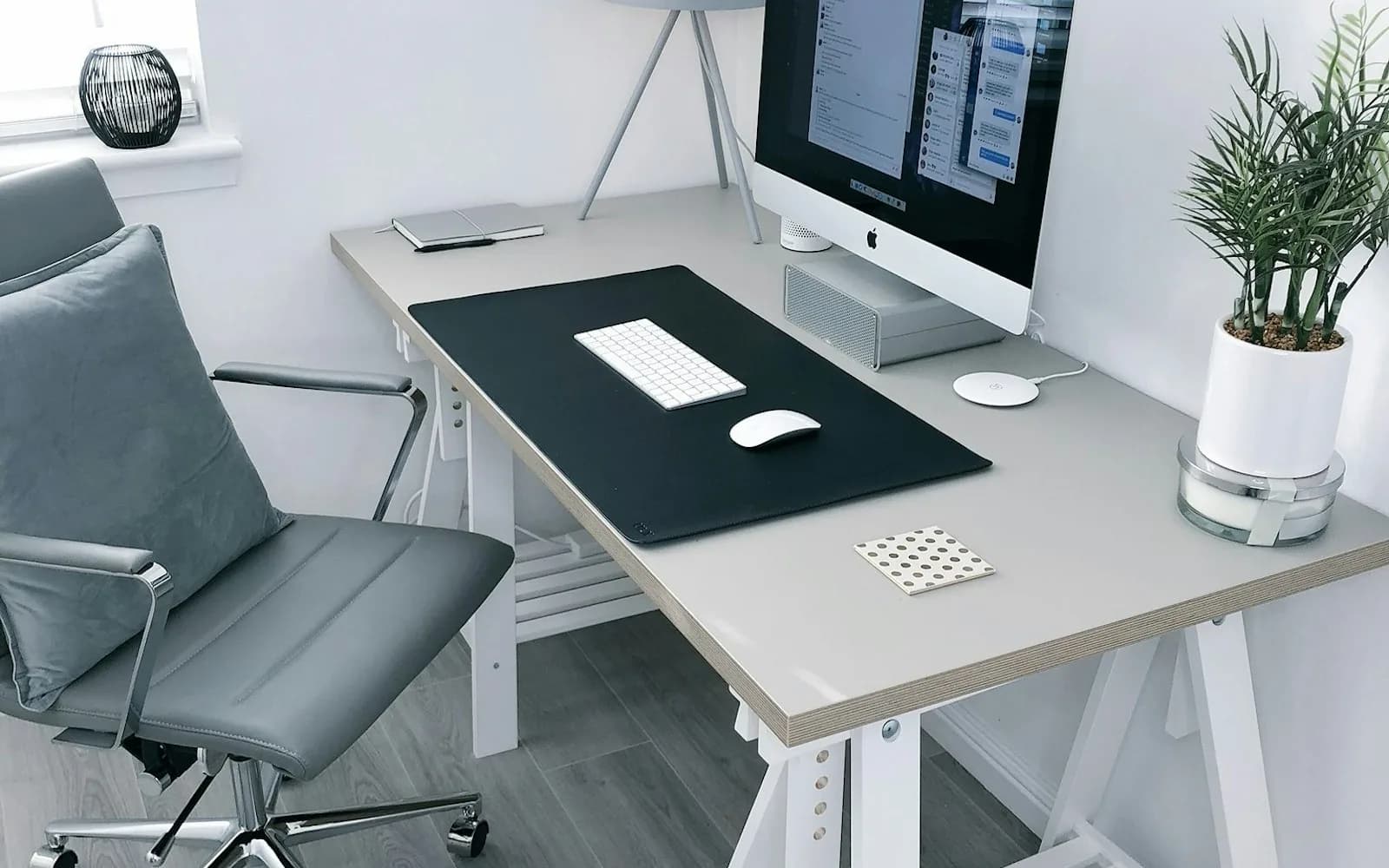
A pale desk with a monitor, lamp and a single plant
There is a particular kind of desk that looks productive and feels impossible to work at. It has a label maker, three charging cables, a tray for receipts, a dish for paper clips, and a small forest of objects that were bought to solve a problem that no longer exists. The surface is full. The work is not.
A quieter desk is not an empty desk. It is an edited one. The difference is intention: every object on it has a job, and every job is one you actually do.
Start with the surface
Before buying another organizer, take everything off the desk. Put it on the floor or the bed. Then put back only what you used yesterday. Not what you might use, not what you bought for the version of yourself who journals at dawn — what you touched in the last twenty-four hours.
Most people find that the list is short: a laptop, a notebook, a pen, a glass, a lamp. The rest is either storage or sentiment. Storage belongs in a drawer. Sentiment belongs somewhere you can see it without it taking up the working half of the desk.
Light before storage
The most underestimated object on a desk is the light. A single overhead fixture flattens everything and casts your own shadow onto the page. A small, adjustable task light does the opposite: it makes a pool of attention. Put it on the side opposite your writing hand, angle the shade toward the work rather than your face, and keep the rest of the room dimmer than the desk.
“A quiet desk is not empty. It is edited.”
One object that earns its place
There is usually one object on a good desk that has nothing to do with efficiency: a stone, a photograph, a small vase, a candle. It is not clutter because it is chosen. The test is not whether it is useful but whether you would notice if it were gone. If the answer is no, it is not decoration. It is delay.
The goal is not minimalism as a look. It is a surface that stops asking questions. When the desk is quiet, the work gets louder.
Written by
Morrow Studio